Listen Up

In my former life as a writing instructor and coach there was a homework assignment that I gave students to help them create more authentic dialogue scenes. Students were required to spend 15 minutes in a public place such as the local college campus, mall, or park, and listen for snippets of conversations from people passing by them.

At this point someone in the class would start snickering because we’ve all done this. We’ve all caught parts of conversations and repeated them later to family or friends or played them over in our minds wondering what came before and after what we’d heard.

Writing students easily guessed the second part of the assignment. Fiction writers were supposed to create a story around the dialogue they overheard. Creative Nonfiction writers and Journalists were supposed to present what they heard in its actual context, setting the scene for the reader and often adding commentary on its meaning and relevance.

But writing what we imagine or surmise is not the purpose of the exercise. Listening is.

Listening is a critical skill for writing well.

This is not only true for fiction writers, creative nonfiction writers, and journalists, but also for business and technical writers. After writing dozens of procedures, instructions, manuals, or training presentations, technical writers can make the common mistake of thinking that they are the expert and that the client or committee of co-workers should be doing the listening as the professional writer explains what they need. Instead, the professional writer’s first task is to listen to what the client or committee is saying.

Only by listening can the writer be certain of what to write, how to write it, and who they are writing it for. Only by listening can the writer discover what questions to ask to fine tune the request. The knowledge gathered by listening and asking is essential for producing the content that the reader needs and wants.

Listen first. Ask questions later. Write only when you’re sure of what you know.

Tools don’t make the writer

Twice last week I read blogs and forum discussions involving writers judging other writers by what tools they use.

According to a blogger who writes fiction, you aren’t a real writer if you don’t carry a moleskin notebook and fancy pen with you everywhere. And according to a professional writer in a forum discussion, you aren’t a real technical writer if you use, and especially if you prefer, the most commonly used word processing program rather than the program currently favored by the DOD.

I have carried a moleskin notebook in my past and remember how richly appealing they are to hold and scribble thoughts in. But my notes and writing fragments are just as valuable captured electronically using Evernote on my smart phone. That frees me from lugging around a bag big enough for a moleskin and continually fishing in it for my favorite pen.

I have used several different programs to develop manuals, procedures and instructions, and I enjoy learning new ones whenever possible. But I find that each has its pros and cons and believe that the perfect technical writing software has yet to be designed. I therefore prefer the tool requested or required by the employer or client because that is the tool that enables me to get the job done.

It is beyond my expertise to explain why some writers develop a tool obsession, or why so many humans in general feel they have to put others down to build themselves up. But both are a waste of time and talent.

Writers are writers because of the content they produce, not the tool they use to capture, display or distribute it.

Go forth and write something worth reading.

Men On Bikes Talk To Me

“Don’t scare him,” the man said, quickly walking his bike toward me. “Rescue is on the way.”

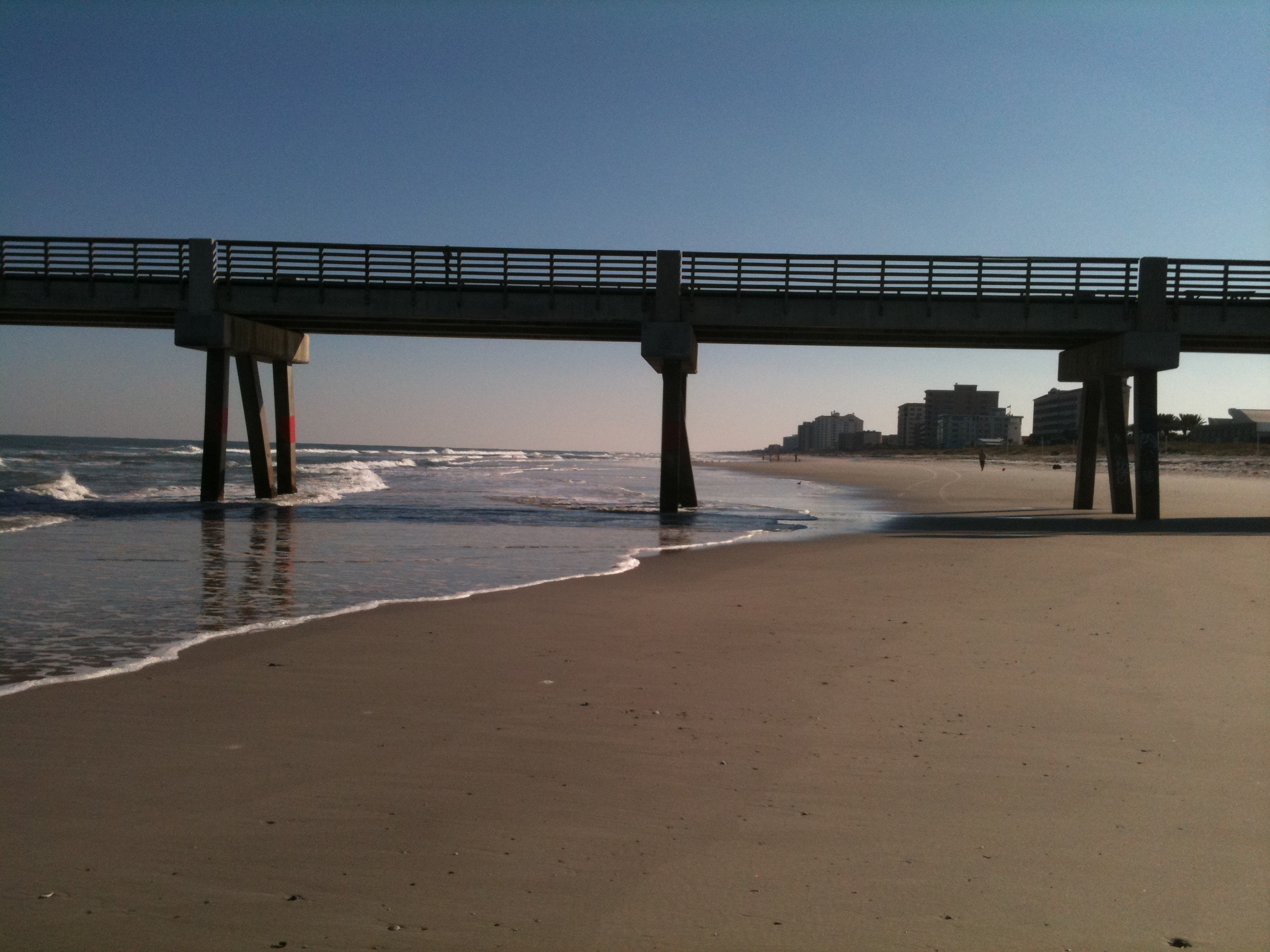
Pelican under Jax Beach Pier

“Him” was a pelican meandering between the pillars of the Jacksonville Pier at the water’s edge. Intermittently he would swim a few feet when the ocean lapped up around him and then return to walking as the water line receded. Several pictures of the pelican were already on my iPhone before the man on the bike warned me to stop.

He wasn’t the first stranger to approach me on the beach. Walking a few miles up and down the coast several times each week puts me in the path of interesting, and sometimes weird, individuals.

Most who stop me as I pass them they want me to take their picture with the ocean behind them. One asked me if it was wrong to take home a shell that still had a creature inside it. Another made a beeline for me so fast that I instinctively took up a defensive posture just as he asked me what a “guy has to do to find a shark tooth around here?!”

Although few are creepy like shark tooth man, I tend to keep my distance and maintain my pace as I pass people. I have my walk to get in and they have their lives that don’t need to include me.

The pelican protector wasn’t creepy but seemed intent on talking to me, so I paused my walk long enough to learn that the pelican had oil on his wings and his protector’s name was Ray. Ray also told me that since the pelican couldn’t fly and therefore couldn’t eat enough on his own, the fishermen on the pier above had been throwing down bait to the bird.

Half an hour later as I made my way back down the coast I found Ray still straddling his bike and keeping watching over the pelican, warning walkers and surfers alike to give the bird space. With his right arm was in a cast, resting on the handlebars, Ray took up our conversation where we’d left off earlier, schooling me on normal pelican behavior and the work of the bird sanctuary to the north that would be picking up the pelican and returning it to health.

As a former surfer and longtime local, Ray knew a more than a little about all things Jax and was eager to share that knowledge. When I told him I was new to the area he launched into a list of parks and beaches I should visit, complete with driving instructions and landmarks to look for along the way. Ray also told me which local bars were the ones to frequent and where I could play a game of pool for a quarter.

I am extra appreciative for that last tip and plan to check it out soon.

I had to leave before the pelican was rescued but trust that Ray made sure everything worked out for the best. I didn’t realize that Ray and the pelican were part a theme week until my next walk, when I was once again stopped by a man on a bike.

This time I was walking with my husband. We were on the return lap, approaching the ocean rescue station, when I saw a man on a bike enter the beach and stop to take in the view. He was wearing a helmet and straddling a significantly upscale bicycle with a small, single-wheel trailer packed full of what looked like spare clothing, bedding and supplies.

“Excuse me,” man on a bike #2 said as soon as I was within hearing range.

“Whatcha need?” I thought maybe he was lost and wanted directions.

Man on a bike #2 knew exactly where he was and what he wanted was to have his picture taken with his front wheel in the ocean. My husband stepped up to oblige, patiently following the man’s instructions regarding the angle and counting to three so that he could pose and flash a peace sign alongside his wide smile.

We quickly learned that man on a bike #2 had just then completed a coast to coast bicycle trek. In 75 days he had traveled from Los Angeles to Jax! We were the first to congratulate him and he was still smiling as we wished him well and left him there to enjoy his moment. We forgot to ask his name, however, so he remains man on a bike #2 for all eternity unless, by chance and internet, he is identified.

In two days I had talked to two men who at first appeared to be striking opposites–the local ocean wildlife guru and the L.A. visitor whose only interest in our beach was getting his tire in the water to symbolize the finish line for a personal journey. What they had in common, besides their mode of transportation, was a unique perspective of our surroundings and a drive to share that perspective with anyone and everyone crossing their path.

Isn’t that a good description of a writer?

From those encounters I take away a gentle reminder to be tiny bit more open to strangers I pass in the sand, on the off chance that they have something unique to tell me. I am also now affectionately referring to the past seven days as Men On Bikes Talk To Me week.

Out of office reply

I haven’t been to my office in several days and I am therefore suffering from a terrible case of beach withdrawal. Wind, rain, and a cold have converged to create the perfect storm to keep me at home and, unfortunately, sedentary, since the beach is also my gym.

I have been combating withdrawal by sorting through the pictures I took last week and, just on the off chance that you are suffering from beach withdrawal too, I thought I would share a few…

Jacksonville Beach Pier

The is my usual view of the pier at Jax Beach as I walk under it. The pier attracts fishermen and people who want a long range view of the ocean and the beach. It also attracts waves, apparently, since most of the surfers congregate on either side of it.

Jax Beach

Some days the beach is extra sparkly. Those are beautiful and inspiring days.

Jax Beach

As the tide goes out, my work space expands considerably. This does not necessarily mean that I get more done, however. A bigger office isn’t always better?

In the interest of getting more done, this will have to do for a beach fix. I may be out of the office today but I still have to work.


In a timely manner, the sequel

Right after posting yesterday’s blog entry, as I was making my rounds through business article sites, I found two articles talking about the persistent problem of poor business writing.

The first, from Forbes, reminds us that words matter. The second, from a website for HR personnel, focuses on workers feeling that their colleagues don’t communicate well.

Although these articles vary in perspective, they have a couple of things in common. One is the overuse and misuse of the word “cascade” in the business world. And two, that there definitely is a problem.

I wrote yesterday that poor business writing was so common that it rarely prompted comment anymore. I am happy to be wrong about that!

In a timely manner?

In my former career lives I have been a newspaper reporter, editor, and publisher. From my earliest reporter days I learned that a deadline is just what it says, the line you must not cross or you’ll be dead.

As a reporter you’ll be figuratively dead. As an editor it gets more serious and as a publisher, missing deadlines means missing the checks from all those advertisers or readers, and therefore, being career dead.

The definition of deadline, per Dictionary.com, is “the time by which something must be finished or submitted; the latest time for finishing something…”

MUST be finished. The LATEST time for finishing.

Why am I harping on something so basic? Because it apparently isn’t basic.

I cruise online job postings each morning, not because I am looking but because I like to keep up with the terminology used when hiring others who do what I do. This is usually a rather sleepy task that doesn’t require a lot of thought on my part and therefore goes well with my first dose of caffeine for the day. But this morning was different.

This morning I read something that set off my inner Grammar Queen and woke up my former journalistic self.

In a posting for a Documentation Consultant, under the heading “Desired skills we seek” was this…

Ability to meet deadlines in a timely manner

Are they being redundant? Judging by the heading, that was my first guess, given that “desired skills” implies they are the skills the company is seeking, rendering “we seek” useless extra.

Or are they truly unaware that a deadline is a firm, unwavering thing? Adding “in a timely manner” implies that deadline in that company means suggested completion date. It’s now a wish list. A plea?

Poor writing leads to confusion, questions, and, in my home, an early morning rant about the lack of knowledge and professionalism in the business world. Of course, it’s nothing new. Grammatical errors, jargon, and business-speak litter not just job postings but also business web pages, corporate publications and now social media. It’s so commonplace that it rarely draws comment anymore.

But that doesn’t mean that readers and consumers of their information don’t notice the apparent disregard for professional writing and clear communication. It’s difficult to quantify how that affects business. Do companies lose sales? Potential employees?

I think they do.

That’s why companies should hire professional writers.


Nobody reads the manual?

Google nobody reads the manual and you’ll get a list of pages that range from tech writers lamenting that their efforts are wasted to tech support complaining that they get calls from users who not only don’t read but probably can’t read the manual. It’s all very negative, not toward the manual itself, but toward the reader, or more accurately, the non-reader.

Just last weekend my husband asked me to hand him the manual for our car. He wasn’t looking to cure insomnia and he didn’t start at the beginning and read straight through. What he wanted to know was what type of power steering fluid to buy and add to the car. In years past he has consulted the manual for other important information such as the correct type of coolant and the location of the serial number of our factory-installed radio.

As I watched him thumb through the pages to the desired information and then hand the manual back to me, I remembered that nobody reads the manual and wondered why we accept that as truth? And why we blame the reader?

One of the most basic tips for writers is to know (and respect) your audience. If the manual is going to be read, who will be doing the reading? What information do they want? Need?

A manual is not likely to be read cover to cover like a novel. In my experience it is usually consulted to solve a specific problem and even then only as a last, or next to last, resort. It’s safe to say that the average manual reader is already out of patience before opening the cover and searching for a table of contents or index.

If we want a manual to be read, it must be written with the end user, the reader, in mind rather than written to please an executive or a technical writer.

If we organize and write manuals in a way that makes sense to their readers, with the information readers want most easily accessible, the manual still won’t be read in the traditional sense, but it just might be used in a pinch before resorting to calling tech support.

And isn’t that really what a manual is for?


Beach, Beach, Beach

This is the entrance to my office.

And this is my view…

I don’t necessarily type a lot here, but this is where I do my best work. It’s where the words come easily and weave into whatever I want to create.

The beach is always the same thing only different. Sand, water and wind carve out new niches, uncover what has been hidden, and reclaim what was just there a moment ago.

That is the sameness, the steadiness. But what is exposed and what is smoothed over changes day to day, hour to hour, moment to moment.

That is the difference, the endless creating and recreating of something new.

The beach is where can’t gives way to can, and where new beats up on same old same old.

Some might call the beach my muse, but it doesn’t whisper in my ear words that only I can hear. Rather, the rush of the wind and the crash of the waves drown out all of the noise of the world around me and inside my head, leaving me with a clean and quiet slate, a blank page on which to create.

The beach is as important to my writing process as the keyboard and the screen. It’s more important, ultimately, because the beach is what gets me started.

The end of the beginning

Well here we go. I signed up in October and I’m finally getting around to adding my first blog post. Doesn’t bode well for the future does it?

Don’t be fooled by the delay.

My son didn’t talk much, or really at all, until he was about two. But once he started he couldn’t be stopped. He even talked in his sleep. Eighteen years later he can still make our ears bleed. It was the getting started that was hard.

We have that in common.

I’m not new to the writing life or to publishing. But after nearly three decades of writing in public I still find it hard to get started. My perfectionism pegs in the red zone. I want the first words, first chapter, first column, or first paragraph of an article or editorial to WOW.

That’s not realistic. It’s not productive. It’s a flow chart to a perfectly blank page.

If beginning is the problem then ending the beginning is the logical solution and the only one that has worked for me consistently over the years.

So here we are at the end of the beginning. Welcome to my blog!