

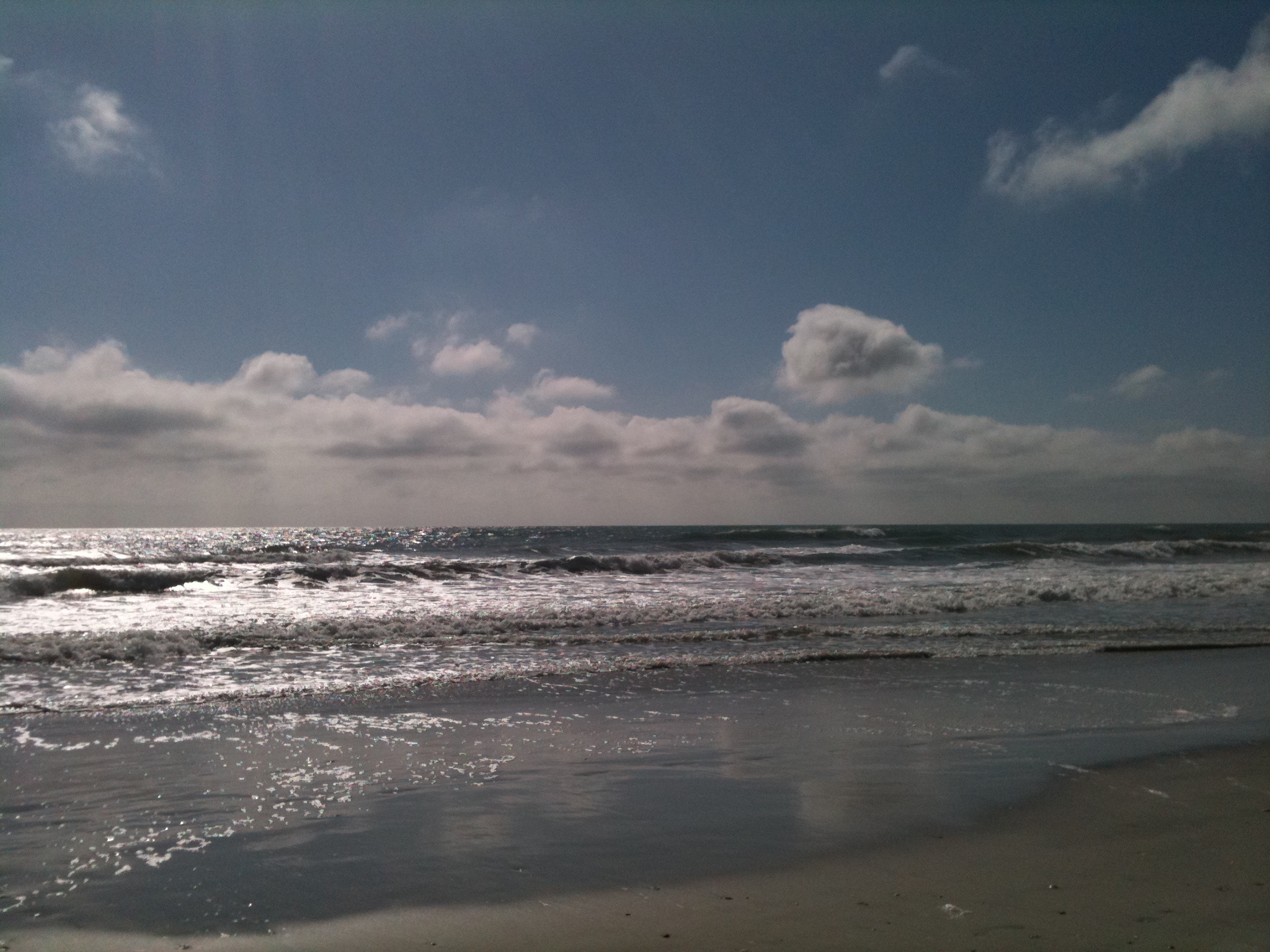
Jax Beach, 5-21-2012, part of my writing journey today and mentioned in today’s writing journal entry as “sparkly.”
A common tip given to writers is to keep a journal. This tip is usually followed either by silence (as if just saying the word journal is enough) or a list of suggestions that feel a lot more like rules. This tip is often met either with an almost fanatical enthusiasm or varying degrees of disdain.
It doesn’t have to be that way. Journaling is good advice, that I have received and given throughout my writing life. It’s also a lesson in writing as a habit and way of life that I have learned and relearned, hopefully for the final time (fingers crossed).
Over the years, as I have given this advice to fellow writers and writing students, I have found that the same questions are asked. Here are the ones I’ve been asked most often, with my answer/opinion, of course.
Do I really have to journal?
No, of course not. But why don’t you want to?
My experience as a writing teacher/mentor, and as a writer, has been that resistance to keeping a journal usually comes from thinking that there is a certain way that a journal should be written and kept, and finding that way unappealing.
There is no one right way or wrong way to journal. Don’t google journaling tips and think that what you read is a blueprint you must follow exactly. You are free to incorporate any ideas that appeal to you and change your mind at any time. The purpose of a journal is to make writing a habit and keep it that way. Writer’s write but few writers write something substantial every day, or every week, or sometimes every month or (gasp!) longer. Journaling keeps a writer writing between projects and ideas.
Should I keep a writer’s journal or a diary?
Yes.
Let’s start with a definition. A journal kept by a writer is a writer’s journal and each is unique to its master/mistress. Some writers keep journals that look like writing class homework notebooks, containing the results of various writing assignments, prompts, and projects. Some writers keep stream-of-consciousness journals with entries that tend to look like the author vomited words onto a page with no further thought or organization. Some writers journal their writing process, meaning they write about writing. Some writers keep diary style journals with entries detailing boring days butted up against story fragments, and an impromptu haiku. Some writers journal the first draft of any writing project so that they never face a blinking cursor on a white screen with no idea where to start.
Each one of these is a writer’s journal, even if when placed alongside each other they don’t even resemble the same species.
I have kept each of the types described above, and various hybrids. For the past seven years, my non-work writing projects have consisted almost exclusively of creative nonfiction–memoir and essays of various lengths. Writing creative nonfiction about my own life is much easier for time periods with diary-style entries, therefore I devote a portion of my daily journaling to those. But I also include ideas, thoughts, and snippets of writing projects. I have started essays in journal entries to avoid the blinking cursor. I do a little bit of everything except journal writing assignments/prompts. Typically those get their own writing files separate from my journal.
Should I keep my writer’s journal handwritten or electronic?
It just doesn’t matter. Do whatever you want. The point is to start and maintain a writer’s journal.
I used to keep handwritten journals, many with a favorite pen, some in moleskines. Others in generic notebooks. About two dozen in both hard and soft cover journals bought from local bookstores. Lined. Unlined. In 1996, grounded off of keyboards for three months due to a bout of carpal tunnel, I wrote an entire novel manuscript by hand in a couple of journals. But for the past few years my journals have gone exclusively electronic. Thanks Evernote!
Do I have to write in my journal every day?
No, of course not. There are no writer’s journal police. But writer’s write. Do you really want to go a day without writing?
I have been journaling full-time since 1994, almost twenty years now. Before then, my journaling was rather hit or miss. And over the past couple of decades there have been two or three long spans of time (one of more than a year) when I didn’t journal at all. Not coincidentally, during those times I also did not write anything else outside of the workplace. No books. No essays. No letters to the editor. Zip. Zero. Once I noticed that pattern I made journaling a priority and haven’t stopped since. I have some journal entries that essentially consist of “I got nothun.” But I have journal entries. Because I don’t really want to go a day without writing ever again.
Do I have to write properly in my journal (meaning with correct spelling, sentence structure and punctuation)?
Again, there are no writer’s journal police. But what is the appeal of writing “improperly?”
I have been referred to as a Grammar Queen and I insist on taking that as a compliment even when it’s not meant as one. I do believe it’s important to know the rules before breaking them. But I don’t think there’s much, if any, value to throwing them all out the window and insisting that’s art. If the point of keeping a journal is to write, and by doing so, improve as a writer, it would seem to me that writing properly would be desirable.
That being said, a writer’s journal is written by the author, for the author. It need not please anyone else.
What should I write about?
Whatever you want. I firmly believe that it does not matter.
I frequently journal about my beach walks. How far. How long. The weather. The waves. Who I shared the beach/my walk with. If I spoke to anyone. What I saw. I can easily tell you which days I’ve watched an osprey catch a fish or pelicans skim the waves in formation. I have logged what shells I found and what kinds of jellies I’ve had to step around. My attraction to and experiences along the coast are obviously an important part of my writing journey and naturally a part of my writer’s journal.
My journal also includes snippets of conversations I’ve had or overheard, topics we discussed as a family over dinner, detailed accounts of good, bad, and indifferent experiences I’ve had, and the fact that I made my taco salad upside down today. My journal is my place to write without self-censorship so if it pops into my mind while my journal is open, then there it is preserved on the page.
Is there a minimum amount I should write?
Nope. You may read or hear advice to write daily. You may encounter suggested word count minimums. You may disregard all of that. It’s your journal. Keep it when, how often, and in whatever length segments you want.
My journal entries over the years tend to be snowflakes. No two are the same. I write whatever and how much I feel like writing and I try not to allow lengthy gaps between entries since, as I noted above, for me, going without journaling coincides with going without writing. I now write something every day. Something. Every. Single. Day.
Should I share my journal with others?
That’s entirely up to you. Many writers journal through their public blogs, giving readers a window on their process and progress. Many more keep journals locked away or password protected hoping they are never read by anyone while they are alive or even after their death.
In our household, journals are nonnegotiably private, including between spouses. That doesn’t mean we don’t occasionally read aloud to each other if it’s relevant to a writing/literary/similarly artistic discussion. We are both writers, after all, and there are times when sharing a passage is the best way to communicate. But such sharing is rare and short-lived and the rest of what we journal is kept secret.
Keep your journal private. Make your journal public. Or strike a balance in between. It’s your choice.
Well there you have it. If you are or want to be a serious writer, and you don’t already keep a journal, give it a try. If you have any questions I haven’t answered, please ask. I’ll do my best to answer. Also, if you are primarily another type of artist, I’d love to hear if you have an equivalent to the writer’s journal. Something that provides a regular opportunity to practice or try out new ideas or just keep you artistically active between projects? Or is this just a writer thing?

 The Beach Writer